Kosmo and Ropedia Partner to Build Scalable Real-World Data Infrastructure for Physical AI
Kosmo, a 3D world data engine, and Ropedia, a Singapore-based startup building data infrastructure for physical AI, today announced a strategic partnership to accelerate the large-scale production of high-quality real-world data for Physical AI development.
By combining Kosmo’s high-fidelity 3D spatial data capture and reconstruction capabilities with Ropedia’s human experience data collection and processing, the two companies aim to establish an integrated pipeline spanning spatial data capture, structuring, standardized delivery and model validation at scale. The resulting multimodal data products are designed to feed directly into the training of foundation models, embodied mobile manipulation models and world models, helping bridge the Sim-to-Real gap in embodied AI.
The collaboration is designed to support leading AI developers and research teams, including those at OpenAI, Meta, DeepMind, NVIDIA, Google and Microsoft.
Ropedia Xperience 2 Demonstrates Scalable Data Collection
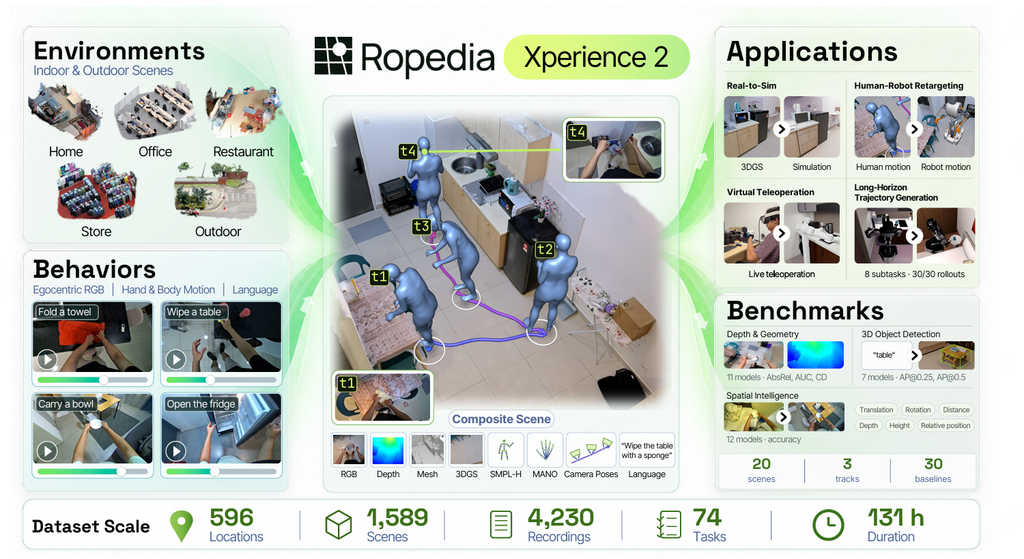
The partnership has already delivered a tangible research outcome. On November 12, Ropedia Xperience 2, a jointly supported research project, was officially released. The project introduces a Physical AI dataset comprising 1,589 metric-scale 3D-scanned environments, 74 tasks and 4,230 egocentric recordings totaling 131 hours.
All 3D environment scans were captured using Kosmo One, enabling static spatial assets and dynamic human experiences to be natively aligned within a shared coordinate system and timeline. The research also demonstrates four pathways for reusing the captured data: real-to-simulation conversion, motion retargeting, virtual teleoperation and long-horizon trajectory generation. Together, these capabilities establish a scalable approach to collecting and repurposing physical environment and human behavior data.
The Xperience 2 research further details Ropedia’s data collection and processing pipeline, incorporating 3D Gaussian Splatting (3DGS) reconstruction, estimation of camera trajectories and hand and body motion, hierarchical language annotation, and spatial registration of recordings to reconstructed environments. Using the scanned environments as reference geometry, the research also evaluates a range of AI models, including GPT-6 Astra and Gemini 2.5 Pro, across depth estimation, 3D object detection and spatial intelligence benchmarks.
High-quality real-world training data remains a critical bottleneck for embodied AI, with a significant gap between existing data supply and model requirements. Current approaches often capture only one dimension of the physical world: 3D reconstruction reproduces environmental geometry and appearance but lacks detailed human-object interactions, while first-person video captures human actions and trajectories but struggles to provide precise and consistent spatial ground truth. Neither source alone provides the comprehensive information models need to understand the causal relationships between actions, physical environments and changes in object states.
The partnership addresses this gap with two complementary data layers.
Kosmo One, the world’s first 8K ultra-high-definition AI spatial camera, combines lidar and 8K imaging to capture the geometry and appearance of real environments, enabling 3D reconstruction with millimeter-level geometric accuracy. Kosmo World turns those scans into interactive 3D scenes, generating 3DGS, mesh and depth data from a single reconstruction.
Ropedia’s head-mounted HOMIE Gen2 system captures first-person recordings of how people move, handle objects, and change their state. Ropedia’s Experience Engine aligns the recordings with Kosmo’s 3D scenes in space and time and annotates the actions and their effects.
Together, the two will establish common capture standards and data formats, along with shared security and privacy requirements. Model and application needs will guide what they collect for training. Tasks that models struggle with during evaluation will inform the next round of data collection.
Other News
Hesai Releases Spatial Intelligence White Paper on Technological Evolution, Industry Trends, and Application Opportunities
November 10, 2026 – Hesai Group (Nasdaq: HSAI; HKEX: 2525) ("Hesai" or the "Company"), a Physical AI infrastructure company, today
White Paper
Pixar’s RenderMan Meets Kosmo: Bringing the Real World Into the Creative Pipeline
From Toy Story to Jurassic Park, one name has been behind almost every major visual effects production in Hollywood for
AnimationFilm
District Cinema × Kosmo: Redefining Virtual Production Workflows with 3D Gaussian Splatting
From The Mandalorian to Dune, LED virtual production is rewriting the rules of Hollywood filmmaking. Actors no longer perform in