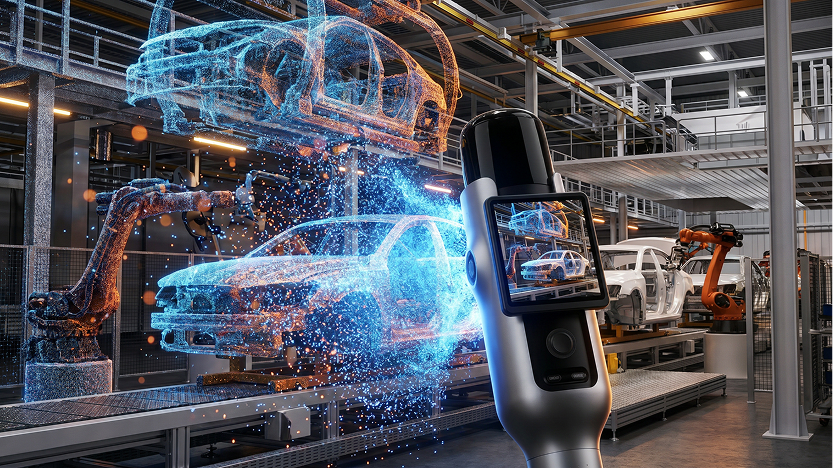
From data generation to deployment validation, Kosmo powers every critical stage of embodied AI training — making real-world data scalable for the first time.
REAL-WORLD 3D DATA IS SCARCE, EXPENSIVE — AND THERE'S NO SUBSTITUTE THAT WORKS.
Embodied AI depends on real-world 3D data to understand and navigate physical space — but capturing it at high fidelity is slow, expensive, and impossible to scale.
Synthetic data seems like a shortcut, until robots trained on it meet the real world and fail: visual inconsistencies and unmatched lighting expose the Sim-to-Real gap every time.
Real-world testing fills some gaps, but at a steep cost in time, equipment, and personnel — making rapid iteration nearly impossible.
The scarcity of quality spatial data has become the fundamental bottleneck holding embodied AI back.
BUILT FOR EVERY TRAINING STAGE
FOUNDATION MODEL TRAINING
Feed foundation models with large-scale, high-fidelity real-world spatial data — so they learn from reality from day one.
NAVIGATION
Digitize real buildings, streets, and complex environments into precise spatial maps and traversability data — giving robots the spatial awareness to navigate the real world.
FINE-TUNING
Rapidly capture high-precision on-site data for specific deployment environments — enabling continuous model iteration and precise adaptation to real-world conditions.
TESTING & VALIDATION
Reconstruct extreme scenarios and corner cases in digital twins — validating robot behavior at scale, at a fraction of the cost of real-world testing.
STAGE FIVE
Feed foundation models with large-scale, high-fidelity real-world spatial data — so they learn from reality from day one.
SUCCESS STORIES
LOREM IPSUM
In a new world full of robotics, a new spatial intelligence emerges and owns the robotic training...
How accurate is the point cloud data this scanner produces?
Under typical indoor conditions the scanner achieves a relative accuracy of ±3 mm at ranges up to 30 m, and ±6 mm out to 80 m. Absolute accuracy improves to ±1–2 cm when the optional RTK GNSS module is attached and a clear sky view is available. For best results, walk at a steady pace of 0.5–1.0 m/s and maintain overlap between passes.
Can I scan outdoors in direct sunlight?
Under typical indoor conditions the scanner achieves a relative accuracy of ±3 mm at ranges up to 30 m, and ±6 mm out to 80 m. Absolute accuracy improves to ±1–2 cm when the optional RTK GNSS module is attached and a clear sky view is available. For best results, walk at a steady pace of 0.5–1.0 m/s and maintain overlap between passes.
What software is needed to process the scan data?
Under typical indoor conditions the scanner achieves a relative accuracy of ±3 mm at ranges up to 30 m, and ±6 mm out to 80 m. Absolute accuracy improves to ±1–2 cm when the optional RTK GNSS module is attached and a clear sky view is available. For best results, walk at a steady pace of 0.5–1.0 m/s and maintain overlap between passes.
How large are typical scan files, and how much can I store internally?
Under typical indoor conditions the scanner achieves a relative accuracy of ±3 mm at ranges up to 30 m, and ±6 mm out to 80 m. Absolute accuracy improves to ±1–2 cm when the optional RTK GNSS module is attached and a clear sky view is available. For best results, walk at a steady pace of 0.5–1.0 m/s and maintain overlap between passes.
What happens if the battery runs out mid-scan?
Under typical indoor conditions the scanner achieves a relative accuracy of ±3 mm at ranges up to 30 m, and ±6 mm out to 80 m. Absolute accuracy improves to ±1–2 cm when the optional RTK GNSS module is attached and a clear sky view is available. For best results, walk at a steady pace of 0.5–1.0 m/s and maintain overlap between passes.
Can I use the scanner while it is plugged in and charging?
Under typical indoor conditions the scanner achieves a relative accuracy of ±3 mm at ranges up to 30 m, and ±6 mm out to 80 m. Absolute accuracy improves to ±1–2 cm when the optional RTK GNSS module is attached and a clear sky view is available. For best results, walk at a steady pace of 0.5–1.0 m/s and maintain overlap between passes.